Sunday, April 22, 2018

Monday, March 12, 2018
Copyright Office Won't Register "Middle Finger Pictogram" As Literary Work- (Eric Goldman)
Copyright Office Won’t Register ‘Middle-Finger Pictogram’ As Literary Work–Ashton v. Copyright Office
Ashton created a coffee mug displaying the words “People Pleaser in Recovery” on the outside, the word “Refill” on the inside bottom, and a single-fingered salute on the outside bottom:
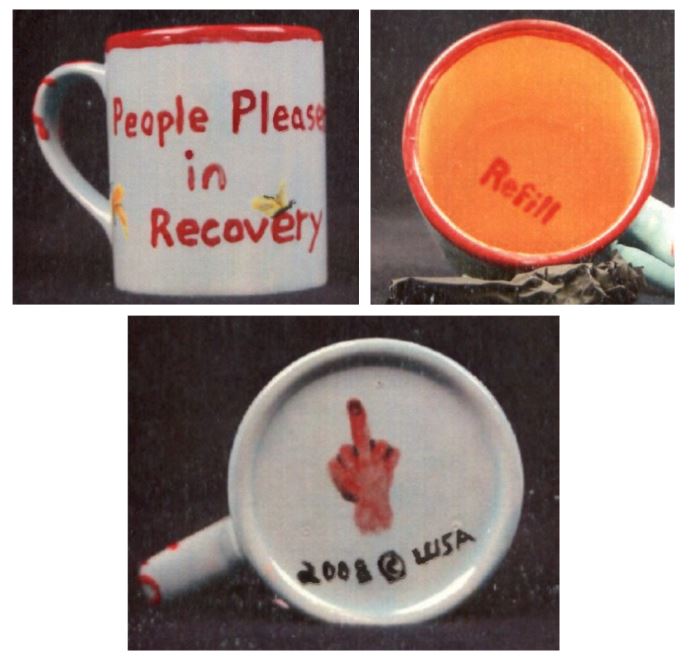
Ashton applied for copyright registrations for 2D artwork and a literary work. According to Ashton, the “text” supporting the literary work copyright consisted of the phrases “people pleaser in recovery” + “refill” + the “pictogram” of the raised middle finger; those elements allegedly comprised a 3-line poem, e.g.:
People Pleaser in Recovery
Refill

Ashton claimed the middle-finger drawing qualified as text, not 2D artwork, because it is a “word, indicia or symbol” (though the actual Sec. 101 definition of “literary work” says “words, numbers, or other verbal or numerical symbols or indicia”). The Copyright Office repeatedly refused the registration for text. Its final decision said:
Unfortunately, the court sidesteps the more interesting question of whether a pictogram can qualify as a literary work. To me, it seems unlikely that any hand gesture, however visually depicted, should ever qualify as a literary work.
This case indirectly addresses the copyrightability of emojis, something I analyze in my Emojis and the Law paper (secret tip: I posted a new draft! I’ll blog about it soon). According to this case, individual emojis shouldn’t qualify as literary works despite their semantic meanings; however, some emojis will qualify for copyright protection as 2D artwork, like this middle-finger pictogram apparently did.
A related trademark issue: is “Bob’s [car emoji]” inherently distinctive because of the (currently novel) combination of Bob with the car emoji, or will the Trademark Office require disclaimer of the emoji (like it would if the word “cars” was used), which would necessitate secondary meaning to register the trademark? I think the latter outcome makes more sense because the car emoji and the word “car” are semantically substitutable.
Case citation: Ashton v. U.S. Copyright Office, 1:16-cv-02305-APM (D.C.D.C. March 8, 2018)
Bonus Hidden Track: Oyewole v. Ora, 1:16-cv-01912-AJN (S.D.N.Y. March 8, 2018). On the same day, a court ruled against a copyright plaintiff claiming that songwriters infringed the phrase “party and bullshit.” Instead of relying on the short phrase doctrine, the court assumes that the phrase is copyrightable and dismisses the complaint on fair use grounds. I guess all’s well that ends well, but fair use analyses look strange when applied to microworks like this. Among other things, the court says the defendants made transformative uses because the copyright plaintiff used the phrase in a politically rebellious song to mock partiers, while the defendants used the phrase as a rallying cry to celebrate partying. (Cf. the Beastie Boys’ well-known 80s anthem “(You Gotta) Fight for Your Right (to Party),” which the band intended to be satirical but most listeners interpreted as aspirational).
Ashton applied for copyright registrations for 2D artwork and a literary work. According to Ashton, the “text” supporting the literary work copyright consisted of the phrases “people pleaser in recovery” + “refill” + the “pictogram” of the raised middle finger; those elements allegedly comprised a 3-line poem, e.g.:
People Pleaser in Recovery
Refill
Ashton claimed the middle-finger drawing qualified as text, not 2D artwork, because it is a “word, indicia or symbol” (though the actual Sec. 101 definition of “literary work” says “words, numbers, or other verbal or numerical symbols or indicia”). The Copyright Office repeatedly refused the registration for text. Its final decision said:
- the individual text components are uncopyrightable words/short phrases/familiar symbols. Thus, the middle-finger pictogram isn’t copyrightable as text on a standalone basis (or is de minimis even if it is)
- the three-line poem doesn’t clear Feist’s creativity standard
- the artwork, including the middle finger, could be registered as such
Unfortunately, the court sidesteps the more interesting question of whether a pictogram can qualify as a literary work. To me, it seems unlikely that any hand gesture, however visually depicted, should ever qualify as a literary work.
This case indirectly addresses the copyrightability of emojis, something I analyze in my Emojis and the Law paper (secret tip: I posted a new draft! I’ll blog about it soon). According to this case, individual emojis shouldn’t qualify as literary works despite their semantic meanings; however, some emojis will qualify for copyright protection as 2D artwork, like this middle-finger pictogram apparently did.
A related trademark issue: is “Bob’s [car emoji]” inherently distinctive because of the (currently novel) combination of Bob with the car emoji, or will the Trademark Office require disclaimer of the emoji (like it would if the word “cars” was used), which would necessitate secondary meaning to register the trademark? I think the latter outcome makes more sense because the car emoji and the word “car” are semantically substitutable.
Case citation: Ashton v. U.S. Copyright Office, 1:16-cv-02305-APM (D.C.D.C. March 8, 2018)
Bonus Hidden Track: Oyewole v. Ora, 1:16-cv-01912-AJN (S.D.N.Y. March 8, 2018). On the same day, a court ruled against a copyright plaintiff claiming that songwriters infringed the phrase “party and bullshit.” Instead of relying on the short phrase doctrine, the court assumes that the phrase is copyrightable and dismisses the complaint on fair use grounds. I guess all’s well that ends well, but fair use analyses look strange when applied to microworks like this. Among other things, the court says the defendants made transformative uses because the copyright plaintiff used the phrase in a politically rebellious song to mock partiers, while the defendants used the phrase as a rallying cry to celebrate partying. (Cf. the Beastie Boys’ well-known 80s anthem “(You Gotta) Fight for Your Right (to Party),” which the band intended to be satirical but most listeners interpreted as aspirational).
*******
https://plus.google.com/share?url=https%3A%2F%2Fblog.ericgoldman.org%2Farchives%2F2018%2F03%2Fcopyright-office-wont-register-middle-finger-pictogram-as-literary-work-ashton-v-copyright-office.htm
Saturday, February 24, 2018
Reconceptualizing ‘Afrollywood’ Creative Landscape-Samuel Samiai Andrews*
Reconceptualizing ‘Afrollywood’ Creative Landscape
[1] Background
[1] Background
The international creative communities led by the United
Nations have initiated several treaties to regulate the use and compensation
systems of cultural materials.[1] Earlier this Chapter,
examined some of the efforts of the UNESCO and WIPO in adopting a legal regime
that is globally acceptable for protecting proprietary rights of indigenous
peoples or traditional societies’ creative products and contents.[2] The recent Marvel and Walt
Disney Studio’s production of ‘Black
Panther’ elicits a continued debate
for the proper value or compensation that African communities deserve, for the
use of its folklore, art craft, fashion designs, songs and sacred creation in a
derivative cinematographic work.[3] I propose the
reconceptualization of intellectual property laws, especially copyright laws, to protect and compensate African and
cultural communities for the use of their creative products in commercial
cinematographic works made by creators outside the source communities.
[2] ‘Wakanda’: Cultural Anachronism &
Cinematographic Appropriations
Professor Olufunmilayo Arewa contends that certain ‘borrowing’ of
African cultural works in the context of a commercial song like in the example
of the “The Lion Sleeps Tonight” may cross a line into appropriation of
creative culture.[4]
Extending Professor Arewa’s argument further, this chapter contends that in the
light of the history of colonial exploitative adventures of the Western
colonist on Africa and the digital era technological advantages of the
developed economies. The international communities of nations should
renegotiate an intellectual property regime with traditional communities in
Africa and other continents, that recognize the exploitative intersections of a
‘borrowed’ African creative culture, folklore, artwork, song, sacred
institution and fashion design.
The movie ‘Black Panther’ depicts and uses both fictional
and African creative contents.[5] For example, the fictional
African nation in the movie, Wakanda’s elite female guard draws on the
traditions from Kenya, South Africa and Namibia. Another example for purposes of intellectual
property law intervention is King T’Challa of Wakanda wearing a tunic with an
embroidered collar like those worn by Yoruba men in Nigeria.[6] The producers of ‘Black
Panther, perhaps for legal and artistic reasons attempted to create a
derivative art form by combining cultures of different African ethic peoples
which may create a new form of culture or art form not in existence.[7] The cultural anachronism,
however does little to shield the appropriation of the inherent cultures that
forms the basis of the screenplay.[8]
The default defense for appropriation of cultural
creative works swings between fair use and public domain uses.[9] However, when a cultural
work is use like in the case in point with ‘Black
Panther’ and the movie has earned huge income for the ‘borrower,’ equity,
law and fairness demands a fair compensation for the owners of the culture.[10] This Chapter argues that
a starting point for legal and equitable compensation of African creative
culture is the renegotiation of current intellectual property jurisprudence and
treaties.
[3] ‘Black Panther,’ ‘Wakanda’ & African Folklore: Instances of
Cultural Appropriation
The movie appropriated
real life African tribes (not fictionally derivative); the ‘Maasai’ tribe lives in kenya, the eastern part of Africa and
the ‘Dogon’ tribe lives in mountains of East
Africa (inspiration for ‘Jabari’ tribe
in the movie).[11]
The producers of the movie appropriated the photo of a known Nigerian chief in traditional Yoruba royal regalia and fashion design for its advertisement and marketing pitch.[12] The appropriation of the Dogon tribe of East
Africa’s, sculpture, sacred rituals of astronomy, and traditional fashion
designs associated with the indigenous performances.[13] The appropriation of the
traditional fashion designs of the Ndebele people of South Africa.[14]
*Except from draft work of SJD dissertation.© All Rights Reserved, Samuel Samiai Andrews, 2018. Comments are welcome to author @ samiandrews40@gmail.com.
[1] See, Olufunmilayo Arewa, Cultural
Appropriation: When ‘Borrowing’ Become Exploitation, The Conversation (June
20, 2016) available at https://theconversation.com/cultural-appropriation-when-borrowing-becomes-exploitation-57411, also available at https://www.huffingtonpost.com/the-conversation-africa/cultural-appropriation-wh_b_10585184.html
[2] Id.
[4] See, Arewa, supra, note 1.
[5] See, Mallory Yu, ‘Black Panther, Costume Designer Draws On ‘The Sacred Geometry of Africa,’
NPR.org (Feb. 16, 2016) available at https://www.npr.org/2018/02/16/586513016/black-panther-costume-designer-draws-on-the-sacred-geometry-of-africa
[6] See, Zeba Blay, From Zamunda
to Wakanda: How ‘Black Panther’ Reimagined African Style, Huffington Post
(Feb. 16, 2018) available at https://www.huffingtonpost.com/entry/how-black-panther-reimagined-african-style_us_5a7730e0e4b01ce33eb3e6d5
[7] Id.
[8] See, Jelani Cobb, “Black
Panther” and The Invention of “Africa,” The New Yorker (February 18, 2018)
available at https://www.newyorker.com/news/daily-comment/black-panther-and-the-invention-of-africa
[9] See, § 3.4 [C], supra at ___- ____.; See also, § 5.3
[E], infra at___-___; See e.g., §5.8 [C], infra, __- __.* (citation omitted)*
[10] See, Arewa, supra note 1.
[11] See, Zeba Blay, supra note 6.
[12] Id.
[13] Id.
Thursday, April 7, 2016
Nollywood: Locating A Cultural Creative Industry In Cyberspace Regimes
The Digital era has opened up the inequities and capacities which exist in current distributive and performing apparachtik of the emerging cultural content industry. Nollywood, Nigeria is leading the emerging economies in setting a template for change in political economic renaissance...
@SSA Samiai All Rights Reserved © 2016.

http://www.linkedin.com/in/samuelandrews1/

http://www.linkedin.com/in/samuelandrews1/
Friday, February 26, 2016
Nigerian Social Media Law, Nollywood & Copyright Policy
Click this link to read the full story: http://nigeriastandardnewspaper.com/ng/nigerian-politicians-scared-and-afraid-of-social-media-samuel-andrew-doctoral-student-on-digital-new-media-digital-copyright-nollywood-films-suffolk-university-law-school-bostonsays/
Sunday, January 10, 2016
SAMIAI: DILUTION AND TARNISHMENT OF NOLLYWOOD MARK AND TRA...
SAMIAI: DILUTION AND TARNISHMENT OF NOLLYWOOD MARK AND TRA...: DILUTION AND TARNISHMENT OF NOLLYWOOD MARK AND TRADEMARK: PARTISAN POLITICAL ENDORSEMENTS In the field of trademark, franchise, celeb...
SAMIAI: NIGERIAN ELECTIONS- Bayels and Akwa Ibom Parallels...
SAMIAI: NIGERIAN ELECTIONS- Bayels and Akwa Ibom Parallels...: #NIGERIA- Bayelsa & Akwa Ibom Parallels. The New Political ruling party in Nigeria, All Progressives Congress (APC), are trending...
Subscribe to:
Posts (Atom)