Popular Posts

Thursday, June 9, 2022

Mr Umo Eno and the credibility Question-Akwa Ibom Governorship Race 2023


By now anyone reading this piece or familiar with public commentary would know that majority of Akwa Ibom State do not support Mr. Umo Eno’s (or is it Eno Umo) ambition to become the next governor of Akwa Ibom State. 


Apart from his scandalous kneeling down before Mr. Udom Emmanuel the current Governor to elicit ‘anointing’ and curry a free pass, which shows a sign of weakness and incompetence, the crux of my position in this piece is Mr. Umo Eno’s fraudulent acts of claiming phantom educational qualification as one of his qualifications to be a governor. 


This in my opinion and that of reasonable men and women of Akwa Ibom should be a serious signal that the State is about to be sold into another path of rudderless governance and its people inflicted to continuous suffering.


Let me start with what is actually in the public domain. Mr Umo Eno published his resume through his official campaign publicity-media team with false and misleading information that he graduated from St Francis Secondary School Eket and Victory Secondary School Ikeja with a GCE O level Certificate in 1981. This to me was the first sign of deliberate misinformation and fraud. 


How could someone who claimed to be competent and had capacity in human and material resources management draft such a poor and silly resume for public consumption.

For the record, under the Nigerian Constitution you do not need a GCE O’ Levels to contest for a governorship position. So why the cooking of credential? I, the author of this piece graduated from St. Francis Secondary School, Ikot Ataku Eket in 1982 with GCE O Level Diploma/Certificate. The same school Mr. Umo Eno claimed he graduated from in 1981. 


I know of a fact he never took any GCE exams in St Francis Secondary School Ikot Ataku Eket nor graduated therefrom. Actually, he dropped out. He is what we know in the streets and in the real world as a ‘Drop Out.’ Nothing actually corrosive being a drop out. 


But when you attempt to juice your status notwithstanding, you have succeeded in deceiving a lot of people using false and incorrect credentials to get to where you currently are-then there is a serious problem when you want to become the governor of Akwa Ibom State with same fraudulent resume. Then, I personally will have a serious commonsense collison with you because in Akwa Ibom I have a fundamental stake towards its development growth and wellbeing.


On to the acclaimed Victory Secondary School in Ikeja. Mr. Umo Eno has brought out a poorly engineered copy of a school certificate which has “Ikeja” as the place he took his GCE exams, not even the acclaimed Victory Secondary School Ikeja as depicted in his public resume. 


This document just on the face of it is laughable. So, my point is why would Akwa Ibom allow such a man, who is not even required to present a GCE certificate to be a Governor, but has taken such tenuous and amateurish sojourn to juice and cook up a false personality and credential so the people of Akwa Ibom will vote him in as a so called successful “entrepreneur.”


I challenge other gubernatorial aspirants to take on Mr. Umo Eno on his credibility and integrity. Akwa Ibom does not need a fraud and a ‘Manchurian’ Governorship candidate. 


The people of Akwa Ibom Have suffered enough lack and abuse from politicians. If our people must breath a free sense of emancipation from abject poverty and economic backwardness, Akwa Ibom should only present worthy and upright candidates from all the political parties.

©Samiai 2022

*Dr. Samuel Samiai Andrews is a USA Ambassador’s Distinguished Scholar & Professor of Intellectual Property law

Tuesday, February 1, 2022

@Samiai: Whose god? Deaf or Dumb? The arrogance of the Nigerian Political Class-Part I*


I hardly comment on Akwa Ibom State politics because seriously I stopped taking these folks seriously. I am a bona fide Ibibio. My focus here is about Akwa Ibom State, Governor Udom Emmanuel (who happens to come from ONNA, the local government my parents hailed from) and so called “Faith leaders,” who gamble with God’s name and experts in spiritual transactions. These men use the name of God as a currency in their want of relevance and self-driven lucre. 

The subject of Psychology and Law, which I teach among other subjects have taught me certain unknowns of humanity. One of them is that humans deliberately test boundaries even when deep down the reality of the dangers and perils of the testing is well known to them. The recent display of arrogance by Governor Udom Emmanuel who like Napoleon of the relic Roman empire mounted and organized a political stunt of serious consequences in his public funded residence to proclaim his choice of Governor for Akwa Ibom States and loudly sending the “conquered” Akwa Ibom people a message of his preferred choice of a successor. 

I have read lots of his supporters claiming he has the right to make a choice or choose whoever he desires to support in an elective exercise. This line of defense to me is mundane and elementary. That is never the issue. In fact, he does not have the right to use State funded resources to make such announcement but that’s a legal issue we can do a symposium on. The fundamental danger here is the unintended consequences of a sitting and lame duck elected political leader to restrict political space against potential and well qualified political aspirants who should come out so that the generality of Akwa Ibom people in a democracy will make a choice. I do not know what roles Udom Emmanuel played to fight against the military rule in Nigeria but I know lots of us contributed with blood and sweat to win this so-called democracy we are limping-along with now. So why should the governor use the color of his office to intimidate and scare and deprive Akwa Ibom from choosing the best Governorship Candidate. 

I have refused to address this man that knelt his soul away in the pictures circulating all over the Internet because in my views he doesn’t have the capacity to lead a class room in an “Oluwole” elementary school neither the wherewithal of holding the prefectship of a community grammar school in my father’s village. I will come to him in a future piece if he survives the opposition that will floor and drown this so-called voice from god. 

So, let us attempt for a minute to think when this arrogance from sitting Nigerian Governors and elected political office holders started. To be fair to Governor Udom, he did not start this misdirected political behavior. He has only taken it to some brazen and sheer charlatanic levels. Why is the Governor afraid of fellow citizens of Akwa Ibom in his party who have clearly indicated their interest to be governor of Akwa Ibom State? These politicians are well qualified if you ask me. Whether some of them have the capacity to be governor is what Akwa Ibom people should be left to decide. So, Governor, my advice to you, which I am giving free here (others pay big money to get it) be humble now and recant your mistake. History will judge you harshly if Akwa Ibom implodes and I am afraid you may not have any one to blame. 

Former Governor Attah made similar mistake while attempting to impose his son in law on Akwa Ibom State. I can see he is one of your advisers in this journey to Golgotha. Governor Attah, Sir you are about to enter your 2.0 history recreation. Such history never forgives nor forgets so please Sir retrace this mistake for posterity to be kind to you. 

For the so-called “faith leaders” “faith fathers” I am sorry none of you fit that description. That is my judgement and I am entitled to it. Nothing you all did leading to and around this drama of the absurd have any characteristics of God or faith. We cannot be cowed nor pranked with make-believe transactional processes cloth as ecclesiastical encounters. 

Politics is the art of catering for one’s interest. Therefore, should the interest of Governor Udom, the so called “faith fathers” (I wonder why faith mothers weren’t there…shows how shallow these folks operate) and a few recurring political operatives of Akwa Ibom seasonal politics become more relevant than the interest of the generality of Akwa Ibom people, which is simply embedded in good governance: access to happiness for families, access to good employment and income, access to food and necessaries, security for property and persons and freedom to be humans. 

The entrenched political elite in Akwa Ibom Sate have failed its people for the past 15 years, there are minuscular tangible deliverables for the generality of the people of Akwa Ibom State. They should be all ashamed of themselves collectively and individually. Stay tuned…

*Dr. Samuel Samiai Andrews is a Professor of Intellectual Property Law & USA Ambassador’s Distinguished Scholar

© 2022


Friday, April 30, 2021

Why it pays to link products to places and how African countries can do it

 https://theconversation.com/why-it-pays-to-link-products-to-places-and-how-african-countries-can-do-it-151511

-Samuel Samiai Andrews

Around the world, people commonly associate certain foods and products with particular geographical areas. These products are known for characteristics like aroma, flavour, and the traditional knowledge systems used to make them. Legal and agricultural scholars speak of these characteristics as terroir.

For example, coffee from Ethiopia’s Yirgacheffe, Sidamo and Harrar regions is famous for its quality. The Ijebu people of western Nigeria call their processed cassava Ijebu garri. Roquefort cheese and Darjeeling tea are also products associated with certain places.

These kinds of products, which have characteristics unique to their source, can be identified and protected by a type of intellectual property right called Geographical Indications (GI). This right gives economic and financial advantages to the place of origin. The products can be registered with a global treaty registry like the World Intellectual Property Organization. This helps to counter fake products in the international market.

Developed economies, especially in Europe, have benefited from GI protection and promotion since 1994, when they adopted the Agreement on Trade-Related Aspects of Intellectual Property Rights. And as early as 1883, the geographical origin of products was recognised as as aspect of industrial property in the Paris Convention for the Protection of Industrial Property. It accords them protection due to their value in national economic growth.


Women sitting around a table filled with coffee beans.
Ethiopian women drying coffee beans at a farm in Oromia, Shishinda. Eric Lafforgue/Art in All of Us/Corbis/Getty Images

According to a 2020 European Commission study, Europe’s economy gained about 75 billion euros in the 2017 sales value of GI products. This means GI products accounted for 7% of the total sales value of Europe’s food and drink sector. The study also shows that the sales value of GI products doubled on average, when compared with similar products without GI certification. People attach value to buying authentic products from their sources.

As a predominantly agrarian region, Africa could adopt this strategy to boost the economies of rural communities. The second phase of the African Continental Free Trade Agreement (AfCFTA) focuses on intellectual property rights and trade. It’s an opportunity to take steps towards recognizing the economic value of GI.


Treaties

There are two main treaties currently regulating Geographical Indications. They include the Lisbon Agreement for the Protection of Appellations of Origin and Their International Registration (Lisbon Agreement), and the Geneva Act of the Lisbon Agreement on Appellations of Origin and Geographical Indications (the Geneva Act). Together, they are called The Lisbon System.

Most African countries have not signed these GI treaties. Accession to these treaties carries political and economic benefits. Not even Ethiopia and Nigeria – countries with great agricultural potential – have done so. GI status attracts higher revenue streams because of the customary assumption of quality that accrues to these products.

Joining the Lisbon Agreement and the Geneva Act would aid African countries in extending their products beyond their shores. Member countries have treaty obligations to protect GI products from misappropriation and abuse.

For example, Oku white honey from Cameroon, South African Rooibos tea and South African lamb are certified GI products. They enjoy protection outside the continent, leading to enormous financial benefits to their places of origin.

The local producers of GI products and services have inadequate knowledge of intellectual property and economics. Identifying GI products and including them in a formal database requires learning and experience. Therefore, private and public institutions should intervene in guiding producers and farmers. They can do this through the formation of cooperatives and educating members about GI. Producers and farmers should form GI management organisations to help members manoeuvre through the legal landscape. These include registration of products and collection of royalties and licensing revenues.

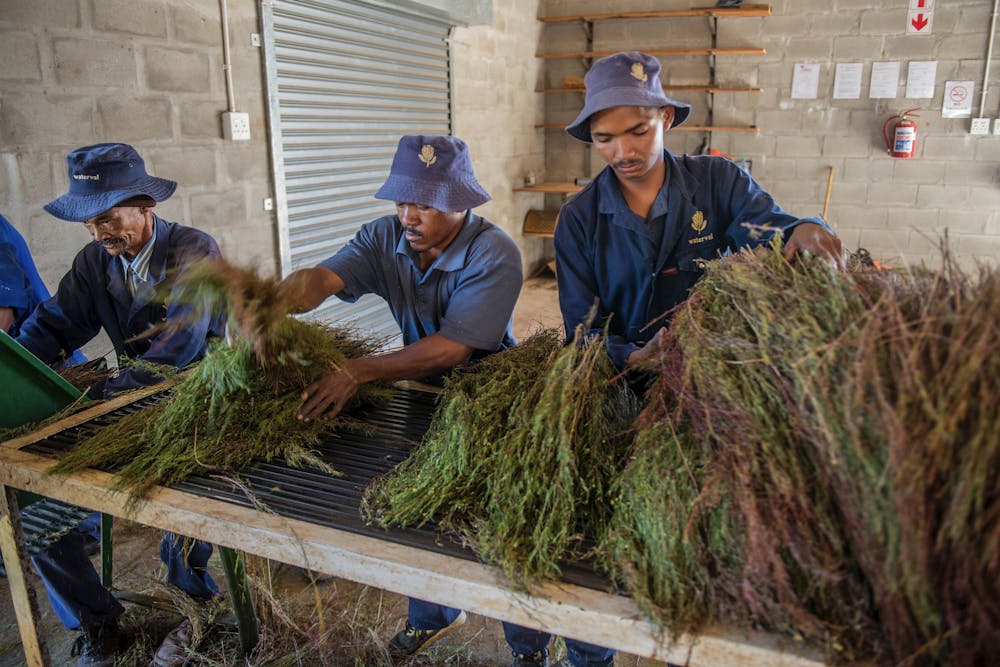
Three men standing at a table and touching leaves.
Farmworkers in the Rooibos tea Skimmelberg farm grade and treat Rooibos tea leaves in South Africa. Mujahid Safodien/AFP/Getty Images

African nations should also streamline their regional intellectual property bodies. Two major African IP regional bodies – the African Intellectual Property Organisation and the African Regional Intellectual Property Organisation – could be merged into a single organisation for efficiency. The Anglophone and Francophone dichotomy in African intellectual property rights management shouldn’t exist. With the AfCTA encouraging a single trade market, a divided IP regional management structure may not be effective.


Nigeria and Ethiopia, like most African countries, do not have a single governmental institution that deals with GI. Although Nigeria’s trademark laws regulate registration, they do not cover GI registry. Ethiopia does not have any law for geographical indications nor a registry.

A specialised governmental office should regulate GI in each African country. For example, Zimbabwe has its Geographical Indication Act. South Africa has its Geographical Indications Regulation of 2019. It sets up its GI registry and guidelines to protect GI agricultural products.

African countries could position GI to help global IP rights enforcement for developing economies. Registration and export of GI products will improve the economy of rural African communities.

Friday, February 12, 2021

Netflix Naija-Creative freedom In Nigeria's Emerging Digital Space


https://theconversation.com/netflix-naija-creative-freedom-in-nigerias-emerging-digital-space-133252