https://www.thecable.ng/nigeria-and-its-lag-in-international-trade-development-and-treaty-polices
March 20, 2019
TheCable Nigeria
https://theconversation.com/why-it-pays-to-link-products-to-places-and-how-african-countries-can-do-it-151511
-Samuel Samiai Andrews
Around the world, people commonly associate certain foods and products with particular geographical areas. These products are known for characteristics like aroma, flavour, and the traditional knowledge systems used to make them. Legal and agricultural scholars speak of these characteristics as terroir.
For example, coffee from Ethiopia’s Yirgacheffe, Sidamo and Harrar regions is famous for its quality. The Ijebu people of western Nigeria call their processed cassava Ijebu garri. Roquefort cheese and Darjeeling tea are also products associated with certain places.
These kinds of products, which have characteristics unique to their source, can be identified and protected by a type of intellectual property right called Geographical Indications (GI). This right gives economic and financial advantages to the place of origin. The products can be registered with a global treaty registry like the World Intellectual Property Organization. This helps to counter fake products in the international market.
Developed economies, especially in Europe, have benefited from GI protection and promotion since 1994, when they adopted the Agreement on Trade-Related Aspects of Intellectual Property Rights. And as early as 1883, the geographical origin of products was recognised as as aspect of industrial property in the Paris Convention for the Protection of Industrial Property. It accords them protection due to their value in national economic growth.

According to a 2020 European Commission study, Europe’s economy gained about 75 billion euros in the 2017 sales value of GI products. This means GI products accounted for 7% of the total sales value of Europe’s food and drink sector. The study also shows that the sales value of GI products doubled on average, when compared with similar products without GI certification. People attach value to buying authentic products from their sources.
As a predominantly agrarian region, Africa could adopt this strategy to boost the economies of rural communities. The second phase of the African Continental Free Trade Agreement (AfCFTA) focuses on intellectual property rights and trade. It’s an opportunity to take steps towards recognizing the economic value of GI.
There are two main treaties currently regulating Geographical Indications. They include the Lisbon Agreement for the Protection of Appellations of Origin and Their International Registration (Lisbon Agreement), and the Geneva Act of the Lisbon Agreement on Appellations of Origin and Geographical Indications (the Geneva Act). Together, they are called The Lisbon System.
Most African countries have not signed these GI treaties. Accession to these treaties carries political and economic benefits. Not even Ethiopia and Nigeria – countries with great agricultural potential – have done so. GI status attracts higher revenue streams because of the customary assumption of quality that accrues to these products.
Joining the Lisbon Agreement and the Geneva Act would aid African countries in extending their products beyond their shores. Member countries have treaty obligations to protect GI products from misappropriation and abuse.
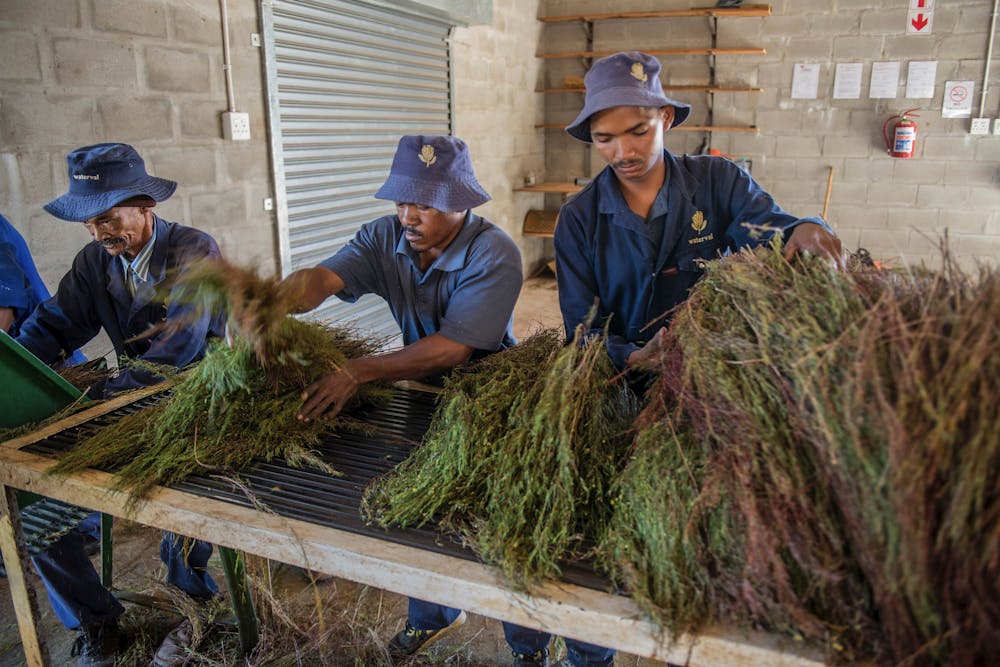
For example, Oku white honey from Cameroon, South African Rooibos tea and South African lamb are certified GI products. They enjoy protection outside the continent, leading to enormous financial benefits to their places of origin.
The local producers of GI products and services have inadequate knowledge of intellectual property and economics. Identifying GI products and including them in a formal database requires learning and experience. Therefore, private and public institutions should intervene in guiding producers and farmers. They can do this through the formation of cooperatives and educating members about GI. Producers and farmers should form GI management organisations to help members manoeuvre through the legal landscape. These include registration of products and collection of royalties and licensing revenues.
African nations should also streamline their regional intellectual property bodies. Two major African IP regional bodies – the African Intellectual Property Organisation and the African Regional Intellectual Property Organisation – could be merged into a single organisation for efficiency. The Anglophone and Francophone dichotomy in African intellectual property rights management shouldn’t exist. With the AfCTA encouraging a single trade market, a divided IP regional management structure may not be effective.
Nigeria and Ethiopia, like most African countries, do not have a single governmental institution that deals with GI. Although Nigeria’s trademark laws regulate registration, they do not cover GI registry. Ethiopia does not have any law for geographical indications nor a registry.
A specialised governmental office should regulate GI in each African country. For example, Zimbabwe has its Geographical Indication Act. South Africa has its Geographical Indications Regulation of 2019. It sets up its GI registry and guidelines to protect GI agricultural products.
African countries could position GI to help global IP rights enforcement for developing economies. Registration and export of GI products will improve the economy of rural African communities.
https://theconversation.com/netflix-naija-creative-freedom-in-nigerias-emerging-digital-space-133252
AfCFTA, Nigeria -Most Favored Nation, National Treatment,
In Africa, most countries are at different stages of economy
development. There are fewer larger and developed African economies
comparatively within the continent. In negotiating the Phase II and IP protocol
of AfCFTA, Nigeria should be conscious of the cultural, traditional and political
stages of development of the Treaty members. In Negotiating the Phase II the
objectives of encouraging inter-regional trade should encourage Nigeria to negotiate
a robust Most Favored Nation (MFN) and National Treatment (NT) clauses so that
Nigerians and Nigeria can trade in products protected by IP in territories of
other member states of AFCFTA without being unfairly and inequitably treated.[i]
The principle of National Treatment generally
means that Nigeria should treat intellectual property protected traded products
or creations of AfCFTA member states as it would treat that of its citizens or
nationals.[ii]
This NT obligation should be based on reciprocity. Nigerian should insist on
the inclusion of these clauses and a practical system to annually assess member
states’ implementation.[iii]
AfCFTA and Nigerian Cultural
Creative Forces
Nigeria should leverage this moment in history to engage AfCFTA
to recognize the protection of its film
(Nollywood), folklore, geographical indications, genetic resources, traditional
fashion, indigenous food products, and plants and other traditional cultural goods/expressions
as trade related intellectual property rights interest. With the background
that the global and some African IP communities have not fully agreed on the
scope of proprietary rights for communal ownership of most indigenous
communities.[viii] In
negotiating AfCFTA IP protocol, Nigeria should push for the attainment of the goals
and objective of real Pan-African inter-nations trade and economic relations
across the continent. The large continent market of Africa could set the pace
for proprietary protection of indigenous food, innovative products. However,
the NOTN should join other IP stakeholder to lobby or promote the total
overhaul and reform of Nigerian IP laws. For example, laws for Geographical indications,
Trade secret, and electronic contracts do not exist in Nigeria. The traditional
IP laws in the books: Trademark, Patent, Copyright and Industrial Designs
suffer legal lag and needs amendment urgently.[iv]
It is when Nigeria has good laws at home that she can stand a better chance of
protecting her trade interest within Africa and globally.[v]
The Digital International Trade and Intellectual Property Approach
Digital era economies are powered by innovative
technologies. In international trade, current legal regimes have adapted its
forms to suit the contemporary means of production. For effective international
and regional trade Nigerians would depend on the power of cyberspace and the
Internet. Imports and exports of food and products largely now depend on
digital means and its regulations. Therefore, Nigeria in negotiating the IP
Phase II protocol of AfCFTA should be conscious that its laws must comply with
the digital spaces. Nigeria should encourage other member states of AFCFTA to
recognize global trade and IP Treaties, which should be incorporated into
AFCFTA regulations and protocol as it suits the African interest and
objectives. This is a great moment to engage the global IP community starting
with the AfCFTA IP Phase II negotiations.
[i]†Samuel Samiai
Andrews, SJD is a Professor of Intellectual Property Law and USA Ambassador’s
Distinguished Scholar, Ethiopia (ADSP) at the University of Gondar, School of
Law, Ethiopia. © 2021, He has recently joined the Faculty of the College
of Law, Prince Mohammad Bin Fahd. Al Khobar-Dammam. Kingdom of Saudi Arabia.
Samuel Samiai Andrews. All Rights Reserved. This article is solely the
personal opinion of the author and does not represent that of any public or
private institutions associated with the author. It is an adaptation from an earlier
published paper with similar theme.
[i] Jacques
Berthelof, Most favored nation (MFN) clause, the Africa’s continental
Free-Trade and the interim Economic Partnership Agreement of Ivory coast and
Ghana, https://www.bilaterals.org/?most-favoured-nation-mfn-clause.
Retrieved 30 April 2021
[ii] Brent Sadler,
Intellectual Property Protection through International Trade, 14 Houston
j. Int’l L. 393 (1992).
[iii] Zhen Kun and Wang
and L. Alan Winter, Africa’s Role in Multilateral Trade Negotiations, https://ssrn.com/abstact=620570,
Retrieved 30 April 2021
[iv] Thomas H. Koenig
& Michael L. Rustad, Global Information Technologies : Ethics And The Law
21-36 (St. Paul, Minnesota: West Publishing, 2018) (describing legal lag as
when legal institutions fail to keep up with the changing social and cultural
conditions of society and quoting Justice Benjamin Cardozo posit that law must
continually evolve to deal with the emergent social realities); See also, Benjamin
Cardozo, The Growth Of The Law 19-20 (New Haven, Connecticut: Yale University
Press, 1973) (emphasizing that “the inn that provides shelter for the night is
not the journey’s end. The law, like the traveler must be ready for the morrow.
It must have a principle of growth”).
[v] Samuel Samiai Andrews, Why it pays to link
products to places - and how African countries can do It, https://theconversation.com/why-it-pays-to-link-products-to-places-and-how-african-countries-can-do-it-151511
Retrieved 30 April 2021
[1] Samuel Samiai
Andrews, Reconceptualizing International Copyright Laws to Protect African
Creative Industries, Vol. 1 Obafemi Awolowo University Law Journal page 217-242
(2018); Samuel Samiai Andrews, Reforming Copyright Law for a Developing Africa,
Vol. 66 Page 1. Journal of the Copyright Society of the USA; Vera Songwe, A
Continental Strategy for Economic Diversification through the AfCFTA and
Intellectual Property Rights, Brookings (January 8, 2020), https://www.brookings.edu/research/a-continental-strategy-for-economic-diversification-through-the-afcfta-and-intellectual-property-rights/;
Brookings, Foresight Africa: Top Priority for the Continent 2020-2030,
Brookings Institute (January 8, 2020), https://www.brookings.edu/multi-chapter-report/foresight-africa-top-priorities-for-the-continent-in-2020/
[1] Jacques
Berthelof, Most favored nation (MFN) clause, the Africa’s continental
Free-Trade and the interim Economic Partnership Agreement of Ivory coast and
Ghana, https://www.bilaterals.org/?most-favoured-nation-mfn-clause.
Retrieved 30 April 2021
[1] Brent Sadler,
Intellectual Property Protection through International Trade, 14 Houston
j. Int’l L. 393 (1992).
[1] Zhen Kun and Wang
and L. Alan Winter, Africa’s Role in Multilateral Trade Negotiations, https://ssrn.com/abstact=620570,
Retrieved 30 April 2021
[1] Thomas H. Koenig
& Michael L. Rustad, Global Information Technologies : Ethics And The Law
21-36 (St. Paul, Minnesota: West Publishing, 2018) (describing legal lag as
when legal institutions fail to keep up with the changing social and cultural
conditions of society and quoting Justice Benjamin Cardozo posit that law must
continually evolve to deal with the emergent social realities); See also, Benjamin
Cardozo, The Growth Of The Law 19-20 (New Haven, Connecticut: Yale University
Press, 1973) (emphasizing that “the inn that provides shelter for the night is
not the journey’s end. The law, like the traveler must be ready for the morrow.
It must have a principle of growth”).
[1] Samuel Samiai Andrews, Why it pays to link
products to places - and how African countries can do It, https://theconversation.com/why-it-pays-to-link-products-to-places-and-how-african-countries-can-do-it-151511
Retrieved 30 April 2021
